
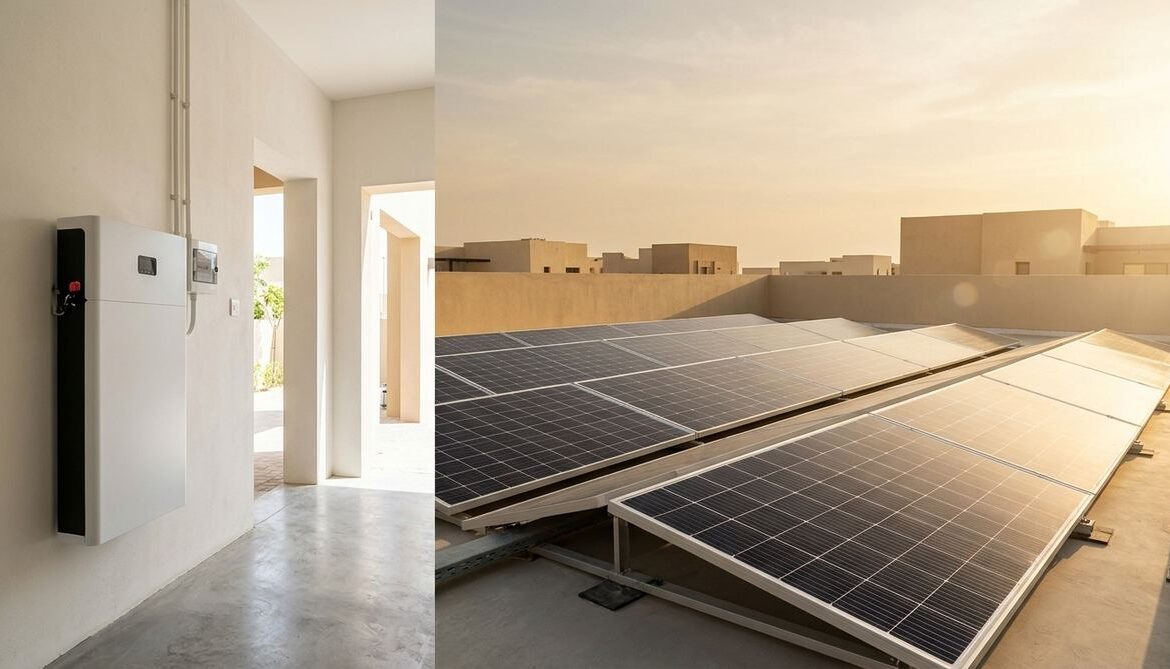
If you run a solar setup anywhere between Dubai, Abu Dhabi, and Muscat, you already know the unwritten rule of Gulf summers: the heat spares nothing.
For years, villa owners, remote farm operators, and commercial facilities relied on traditional lead-acid or gel tubular batteries. And like clockwork, every 18 to 24 months, the same story repeated itself: battery water drying up, bulging casings, drastic capacity drops, and another hefty replacement bill.
By 2026, energy storage in the GCC has reached a turning point. Property owners are no longer asking if they should switch to Lithium Iron Phosphate (LiFePO4)—they are asking how much money they are losing by not switching sooner.
Here is the real, unvarnished breakdown of why LiFePO4 lithium batteries are dominating the UAE and Oman markets, how they survive 50°C ambient temperatures, and the exact math behind the switch.
The 50°C Reality Check: Why Traditional Batteries Die Fast in the Gulf
To understand why lithium is winning, you have to look at the chemistry under brutal conditions.
Lead-acid and AGM batteries rely on liquid chemical reactions that are hypersensitive to heat. For every 8°C to 10°C rise in temperature above 25°C, a lead-acid battery’s lifespan is cut roughly in half. When your battery enclosure hits 45°C or 50°C during a scorching July afternoon in Sharjah or Nizwa, a battery rated for 4 years will barely limp past month 18.
How LiFePO4 (Lithium Iron Phosphate) Behaves Completely Differently:
- Thermal Stability: LiFePO4 has one of the most stable chemical profiles among all lithium variants. It does not release oxygen when heated, eliminating the risk of thermal runaway or explosive combustion.
- Extreme Operating Range: Built specifically with high-tolerance cathode structures, quality solar lithium batteries operate smoothly at ambient temperatures up to 55°C–60°C without breaking down internally.
The Real Lifespan: 6,000 Cycles vs. 800 Cycles
When shopping for solar storage, people often compare battery capacity in Amp-hours (Ah) or Kilowatt-hours (kWh). But the metric that actually dictates your wallet is Cycle Life at Depth of Discharge (DoD).
1. Usable Energy (Depth of Discharge)
- Lead-Acid / Gel: You can only safely drain about 50% of its rated capacity. Draining it below 50% permanently damages the lead plates. A 200Ah battery realistically only gives you 100Ah of real power.
- LiFePO4 Lithium: You can comfortably discharge 80% to 90% of its capacity day after day without degrading the cells. A 200Ah lithium battery delivers 160Ah–180Ah of working power.
2. Total Lifespan
- Lead-Acid: 500 to 1,000 cycles (roughly 1.5 to 3 years of daily solar cycling in UAE climate).
- LiFePO4 Lithium: 6,000+ cycles at 80% DoD. Even after 10 to 15 years of daily cycling, quality LiFePO4 banks still retain 70% to 80% of their original capacity.
The Secret Hero: Smart Battery Management Systems (BMS)
Why do modern lithium batteries require virtually zero maintenance compared to lead-acid? The answer is the built-in Smart BMS (Battery Management System).
Inside a professional LiFePO4 battery pack, a dedicated microcomputer monitors every single internal cell 24/7. It automatically:
- Cuts off current if temperature exceeds safe thresholds.
- Balances cell voltages during charging so no single cell overcharges.
- Prevents deep discharge and short circuits.
- Communicates directly with modern hybrid inverters (like Deye, Growatt, or Victron) via CAN/RS485 protocols.
You don’t check acid levels, you don’t clean corroded terminals with hot water, and you don’t worry about hazardous fumes inside your garage or utility room.
The Financial Calculation: Are Lithium Batteries Actually Cheaper?
The most common hesitation from buyers is initial price: “A lithium battery costs 2.5x to 3x more than lead-acid upfront.”
Let’s look at the true 10-year Cost of Ownership for a typical 10kWh residential or farm solar setup in the UAE:
| Feature / Metric | Traditional Gel / Tubular Bank | Maxima LiFePO4 Lithium Bank |
|---|---|---|
| Initial Upfront Cost | ~AED 5,000 – 6,500 | ~AED 11,000 – 13,500 |
| Usable Capacity | 50% (~5kWh usable) | 90% (~9kWh usable) |
| Lifespan in Gulf Heat | 2 to 2.5 Years | 10 to 15 Years |
| Replacements in 10 Years | 4 to 5 times | Zero replacements |
| Maintenance Cost & Effort | Frequent distilled water, acid checks | Zero maintenance |
| Total 10-Year Spend | AED 22,000 – 28,000+ | AED 11,000 – 13,500 (One-time) |
The math is simple: buying lead-acid isn’t saving money; it’s taking out a recurring subscription on battery replacements. Lithium pays for itself by your first avoided replacement cycle.
Compact, Wall-Mounted, and Clean
Space matters, whether you are outfitting a luxury villa in Dubai Hills, a desert farm in Al Ain, or a workshop in Muscat.
A 10kWh lead-acid battery bank is heavy (often 300+ kg), requires a reinforced steel floor rack, and demands dedicated ventilation due to hydrogen gas venting during charging.
A 10kWh LiFePO4 unit is a sleek, wall-mounted or compact server-rack module weighing a fraction of that. It produces zero emissions, mounts neatly next to your inverter, and occupies less floor footprint than a standard suitcase.
Which Applications Benefit Most in the UAE & Oman?
- Remote Farms, Stables & Chalets: Off-grid locations where utility grid connection is either impossible or exorbitantly expensive to run cables.
- Residential Villas (Hybrid Peak Shaving): Homes aiming to lower summer DEWA / SEWA / utility tariff bills by storing surplus solar power during daylight and discharging during high-rate evening hours.
- Telecommunication & Security Towers: Remote CCTV and telecom stations requiring 99.9% uptime with zero manual maintenance visits.
- Marine & RVs: Yachts, boats, and overland campers needing lightweight, vibration-resistant power storage.
Final Thoughts: Making the Right Choice
Upgrading your solar storage shouldn’t be guesswork. If you are setting up a new solar system or replacing an aged, swollen lead-acid battery bank, investing in high-grade LiFePO4 cells with a robust BMS is the single best decision you can make for reliability and long-term savings in the GCC climate.
Ready to upgrade your storage setup?
Explore Maxima Solar’s Certified LiFePO4 Battery Range engineered specifically for extreme Middle Eastern temperatures, or connect directly with our engineering team via WhatsApp for custom sizing and wholesale quotes across the UAE and Oman.