
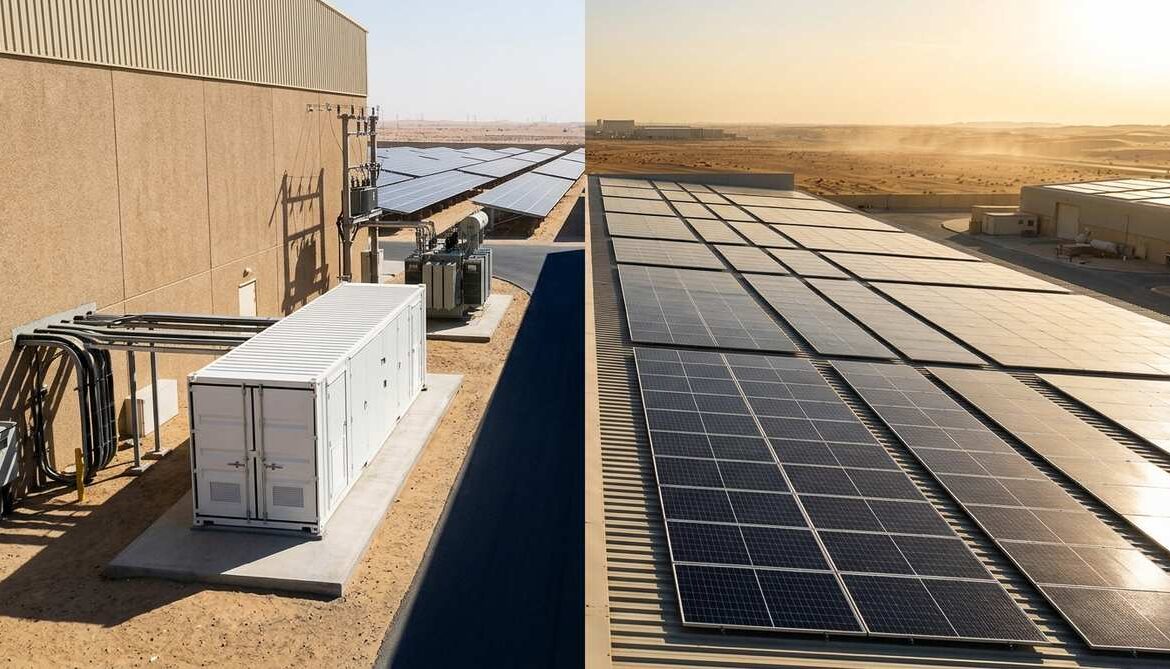
Walk into any industrial hub across JAFZA, Dubai Industrial City (DIC), Mussafah in Abu Dhabi, Sajaa in Sharjah, or Sohar Freezone in Oman, and you will hear the constant hum of diesel generators. For decades, diesel gensets were the only reliable way to power off-grid farms, remote construction camps, cold-storage warehouses, and factories facing grid capacity limits.
In 2026, however, the economics of industrial power in the Gulf have shifted dramatically. Between fluctuating diesel fuel logistics, frequent 250-hour engine servicing, summer overheating shutdowns, and strict municipal emissions rules, diesel generators have become one of the heaviest recurring operational expenses for UAE and Oman businesses.
This is why commercial facility managers and agricultural investors are rapidly replacing—or hybridizing—their diesel fleets with Commercial BESS (Battery Energy Storage Systems) paired with solar PV arrays.
1. What Is a Commercial BESS and How Does It Work in Gulf Conditions?
A Commercial Battery Energy Storage System (BESS) is not just a stack of loose batteries. It is an integrated, outdoor-rated industrial cabinet or containerized power plant that houses:
- High-Density LiFePO4 Battery Racks: Safe, non-combustible Lithium Iron Phosphate chemistry rated for 6,000+ deep cycles.
- Bi-Directional Power Conversion System (PCS): Converts DC solar/battery power into clean, three-phase 380V/400V AC power for heavy motors, chillers, and industrial machinery.
- Active Thermal Management (Liquid Cooling or Industrial HVAC): Engineered specifically to keep battery cells at optimal temperature even when outdoor ambient heat in Al Ain, Liwa, or Muscat exceeds 50°C.
- Automated BMS & Fire Suppression: 24/7 cell-level monitoring, cloud telemetry, and aerosol/gas fire-suppression safety systems compliant with UAE Civil Defense standards.
During daylight hours, your solar panels run your facility’s daytime load and charge the BESS simultaneously. Once the sun sets—or when utility peak-demand tariffs kick in—the BESS seamlessly discharges silent, zero-emission power.
2. The Hidden Costs of Diesel Generators in UAE & Oman
Many business owners compare only the upfront purchase price of a 100 kVA diesel generator against a Commercial BESS. That comparison is misleading because a generator’s purchase price is typically less than 20% of its 5-year Total Cost of Ownership (TCO).
Where Your Money Actually Goes with Diesel Generators:
- Continuous Fuel Burn & Logistics: A 100 kVA generator running at 60%–70% load burns roughly 14 to 18 liters of diesel per hour. Over 12 hours a day, that is 5,000+ liters every month—plus tanker delivery fees to remote farms or desert sites.
- Preventive Maintenance Every 250–500 Hours: Oil changes, fuel filters, air filters (clogged faster during UAE dust storms), coolant flushes, and technician call-out charges add up every single month.
- Low-Load “Wet Stacking” Damage: At night when facility loads drop to 15%–20%, diesel engines suffer from incomplete combustion and carbon buildup—forcing expensive top-end overhauls within 2 to 3 years.
3. Commercial BESS vs. Diesel Generator: 5-Year Operational Comparison
Here is how a 100 kVA diesel genset compares against a 100kWh+ Solar + Commercial BESS setup across key operational metrics in the Emirates and Oman:
| Operational Factor | Diesel Generator (100 kVA) | Solar + Commercial BESS (100kWh+) |
|---|---|---|
| Monthly Fuel Cost | High (Continuous diesel & delivery) | AED 0 (Charged by free Gulf sun) |
| Maintenance & Servicing | Every 250–500 hours (oil, filters, belts) | Minimal (Automated BMS & annual check) |
| Switchover Speed | 10 – 30 seconds (ATS black-out gap) | <10 milliseconds (Seamless UPS) |
| Noise & Emissions | Loud (75–85 dB) & heavy exhaust | Silent & 100% zero-emission |
| System Lifespan | 3–5 years before major engine rebuild | 12–15+ Years (6,000+ LiFePO4 cycles) |
| Typical Payback / ROI | Never (Pure ongoing expense) | 2.5 – 3.5 Years, then 10+ years profit |
4. Three Real-World Ways UAE & Oman Businesses Use Commercial BESS
A. Off-Grid Agricultural Farms & Desalination Plants (Al Ain, Liwa, Sohar, Salalah)
Remote farms running borehole water pumps, RO desalination units, and greenhouse cooling pads often burn thousands of dirhams or rials monthly on diesel. Pairing a 100kWh–215kWh Commercial BESS with ground-mounted solar panels eliminates daytime and nighttime diesel usage while protecting sensitive VFD pump drives from generator voltage spikes.
B. Peak Shaving & Grid Capacity Boosting (JAFZA, DIP, Mussafah Warehouses)
Many industrial warehouses face strict grid transformer limits or high peak-demand charges when heavy chillers and CNC machines start simultaneously. A BESS automatically discharges extra power during peak load spikes—saving you from costly utility transformer upgrades.
C. Hybrid Solar-BESS-Diesel Microgrids (Construction Camps & Resorts)
Already own a diesel generator? You do not have to scrap it. A Commercial BESS acts as the smart microgrid controller: Solar + BESS handles 80% to 90% of daily and nighttime loads silently, while your existing diesel generator stays on standby and only auto-starts if battery reserves drop during rare multi-day dust storms. This cuts diesel consumption by up to 85% and triples your generator’s engine life.
5. How to Size the Right Commercial BESS for Your Facility
- Small Commercial / Clinics / Staff Camps (50kW PCS + 100kWh BESS): Ideal for replacing 60–80 kVA generators, powering lighting, split ACs, cold rooms, and office servers.
- Medium Factories, Farms & Warehouses (100kW PCS + 215kWh Liquid-Cooled BESS): All-in-one outdoor cabinet built for heavy three-phase motor starting currents, RO water plants, and 24/7 cold storage.
- Large Industrial & Utility-Scale Sites (500kW – 2MWh+ Containerized BESS): Modular 20ft/40ft containerized energy storage engineered for major manufacturing plants, mining sites, and remote resorts across Oman and the UAE.
Frequently Asked Questions (Commercial BESS in UAE & Oman)
Can Commercial BESS cabinets survive 50°C+ UAE and Oman summer heat?
Yes. Industrial BESS cabinets designed for the GCC use IP54/IP65 weatherproof enclosures with integrated liquid-cooling or industrial HVAC thermal management, keeping internal LiFePO4 cells cool even in 52°C desert ambient temperatures.
Can a BESS handle heavy motor starting currents (chillers and water pumps)?
Yes. Unlike small residential inverters, commercial PCS units are built with high overload capacity and can pair with an Isolation Transformer to handle unbalanced three-phase loads and high inductive surge currents.
How long does installation take compared to a utility grid upgrade?
A pre-assembled Commercial BESS cabinet arrives factory-tested and can be installed and commissioned in days—whereas waiting for utility transformer upgrades or NOCs can take months.
Get Custom BESS Sizing & Wholesale Pricing from Maxima Solar
Stop burning capital on diesel fuel and generator overhauls. Explore Maxima Solar’s Commercial BESS Solutions or browse our complete Residential & Commercial BESS Systems engineered for UAE and Oman industries.
Planning to Replace a Diesel Generator with Solar + BESS?
Send your kVA generator size or monthly diesel/utility bill to our Dubai engineering team for a free ROI calculation and system quote.