
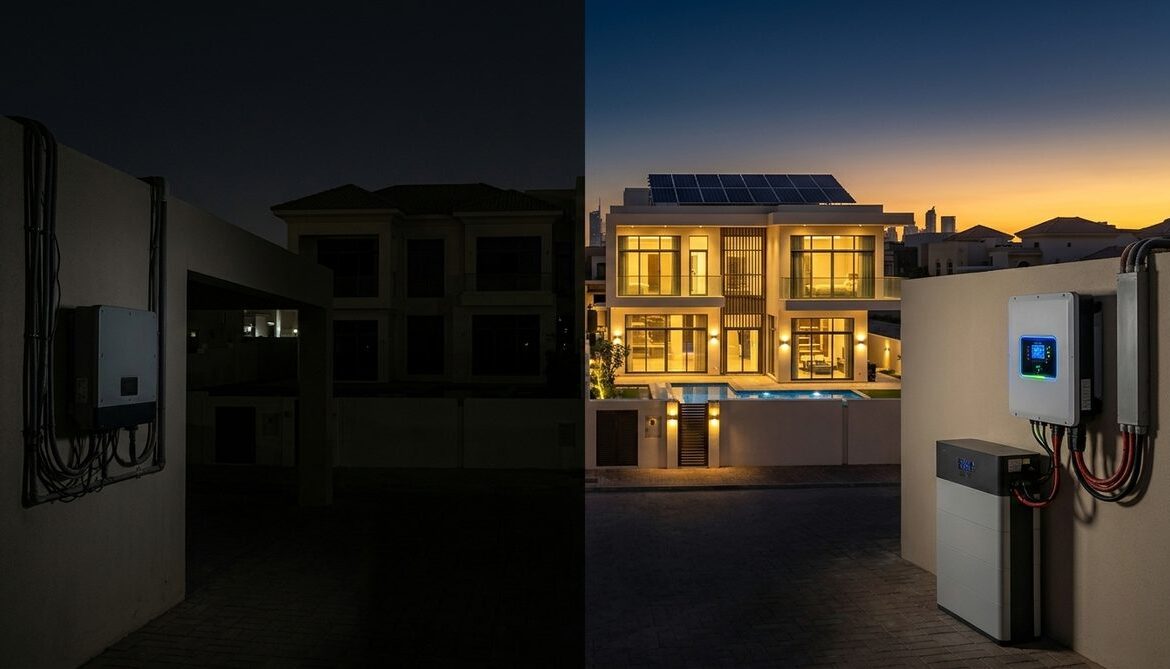
If you are planning to install solar panels on a villa, warehouse, or commercial building in Dubai, Abu Dhabi, or Sharjah, you will immediately run into one critical question: Should you install a standard On-Grid inverter or a Hybrid solar inverter?
Many property owners assume that once solar panels are on the roof, their lights and air conditioners will automatically keep running if the utility grid goes down. In reality, a standard on-grid solar system shuts down completely during a power outage.
In 2026, with rising summer cooling loads, off-grid farm expansions, and evolving net-metering rules across the Emirates, choosing the right inverter architecture decides whether you merely reduce your daytime bill or achieve true 24/7 energy independence.
1. How an On-Grid Solar Inverter Works (And Its Biggest Limitation)
An On-Grid (Grid-Tied) inverter converts DC electricity from your solar panels into AC electricity and feeds it directly into your building’s main distribution board. Under programs like DEWA’s Shams Dubai, excess daytime power is exported back to the utility grid for billing credits.
Where On-Grid Works Well:
- Lower initial hardware cost because no battery bank is required.
- Ideal for factories, offices, and warehouses whose heaviest electricity consumption happens between 8:00 AM and 5:00 PM.
The Catch (Anti-Islanding Safety Rule):
By international IEC and UAE utility safety regulations, every on-grid inverter must include anti-islanding protection. If the grid experiences a fault, maintenance shutdown, or voltage drop, the inverter instantly disconnects—leaving your property without power even at 1:00 PM under bright sunshine.
2. How a Hybrid Solar Inverter Solves Both Nighttime & Blackout Power
A Hybrid Solar Inverter combines a solar MPPT charge controller, a grid-tie inverter, and a smart battery inverter inside a single wall-mounted unit. It manages power intelligently across three sources: Solar Panels, LiFePO4 Lithium Batteries, and the Utility Grid (or Backup Generator).
Why UAE Villa & Farm Owners Prefer Hybrid Inverters in 2026:
- Instant UPS Switchover (<10ms): If grid power drops, the hybrid inverter switches to battery backup in under 10 milliseconds—Wi-Fi routers, servers, fridges, and lights never even flicker.
- Nighttime AC & Peak Shaving: Surplus solar energy generated at noon charges your lithium battery bank, powering air conditioners and home appliances after sunset without drawing expensive grid electricity.
- Future-Ready Expansion: You can install a hybrid inverter today and add or expand your LiFePO4 battery storage anytime without replacing your inverter.
Head-to-Head Comparison: Hybrid vs. On-Grid Solar Inverters
Here is how both technologies compare for residential and commercial setups across Dubai, Abu Dhabi, Sharjah, and Oman:
| Feature / Capability | Standard On-Grid Inverter | Maxima Pure Hybrid Inverter |
|---|---|---|
| Works During Grid Outage? | No (Shuts down automatically) | Yes (<10ms UPS seamless backup) |
| Battery Storage Support | Not supported | Full LiFePO4 & Gel BMS support |
| Nighttime Solar Usage | Relies 100% on utility grid | Runs on stored solar battery power |
| Generator Integration | Not compatible | Auto-start diesel generator port |
| Export / Zero-Export Control | Grid-export only | Programmable Export or Zero-Export |
| Best Application | Daytime commercial roofs | Villas, Farms, Clinics & 24/7 Backup |
What About Zero-Export Mode in Sharjah, Ajman & Private Compounds?
In several UAE emirates, industrial free zones, and off-grid farm developments, exporting surplus electricity back to the main grid is restricted or requires lengthy NOC approvals.
Modern hybrid inverters include built-in CT Sensors (Current Transformers) that enable Zero-Export Mode. Your solar panels power your villa or facility loads first, send every extra watt into your LiFePO4 battery bank, and automatically throttle solar output so zero power flows backward into the utility meter.
How to Size the Right Hybrid Solar System in the UAE
- Small Villa / Essential Backup (5kW – 6kW Hybrid + 10kWh LiFePO4): Ideal for running lights, Wi-Fi, refrigerators, security cameras, and 1–2 inverter split ACs through the night.
- Medium-to-Large Villa (10kW – 15kW Three-Phase Hybrid + 20kWh–30kWh LiFePO4): Built for three-phase UAE residential distribution boards, supporting multiple AC units, pool pumps, and evening peak loads.
- Farms, Workshops & Commercial Facilities (20kW – 50kW+ Parallel Hybrid / BESS): Parallel-capable three-phase hybrid systems designed to slash daytime diesel generator runtime and peak tariff charges.
Frequently Asked Questions (UAE & Oman Solar Buyers)
Can I run a hybrid solar inverter without batteries at first?
Yes. Most pure hybrid inverters can operate in battery-less mode initially like an on-grid inverter, allowing you to connect a 48V LiFePO4 lithium battery pack later whenever your budget allows.
Do UAE villas need a Single-Phase or Three-Phase hybrid inverter?
Almost all modern villas and commercial buildings in Dubai, Abu Dhabi, and Sharjah use Three-Phase (380V/400V) electrical connections. Always verify your main DB breaker before ordering an inverter to avoid phase imbalance.
Get Expert Sizing & Wholesale Prices from Maxima Solar
Whether you are upgrading an existing grid-tied system or building a complete solar-plus-storage setup from scratch, choosing an inverter built for 50°C Gulf ambient conditions makes all the difference.
Browse Maxima Solar’s Pure Hybrid Inverters or explore complete Solar Home Kits with Lithium Batteries ready for fast delivery across the UAE and Oman.
Not Sure Which Hybrid Inverter Fits Your Villa or Facility?
Send your monthly DEWA/utility bill or load list to our Dubai engineering team for a free system quote.